| LACO
| LACO

Data governance bootcamp

Looking to build a solid foundation in data governance within your own organisation? This intensive one‑day, hands‑on bootcamp is delivered exclusively for your team and tailored to your data landscape, governance challenges and objectives.

It offers a clear introduction to data governance, data quality and metadata management, suitable both for newcomers and for professionals looking to refresh or formalise their knowledge.

What you’ll learn

  • Develop a solid understanding of core data governance principles and frameworks.
  • Recognise how to apply these principles effectively within your organisation.
  • Build the confidence to lead or support governance initiatives successfully.
  • Identify common pitfalls and adopt proven best practices for lasting success.

Who should attend

Data Governance Leaders

Data Managers

CDOs

Programme

Morning session:

  • Introduction to data governance
  • Key concepts and definitions
  • Overview of data governance frameworks
  • Roles and responsibilities in data governance

Afternoon session:

  • Developing data policies and standards
  • The role of data quality and metadata management
  • The importance of change management
  • Showcasing use cases and best practices

Location

This training can be held at the LACO office or at your training facilities.

FAQ

What is the required level of prior knowledge or experience for this training?2025-11-26T13:06:45+00:00

No specific prior experience is required. A basic familiarity with general data concepts and terminology (such as data analysis, modelling, or reporting) is helpful, but the bootcamp is designed for both beginners and those with some hands-on experience.

Is lunch, coffee, or catering included in the price?2026-01-12T15:03:42+00:00

When the training is organized at LACO training facilities, lunch and beverages are provided.

Will the training language always be English (or Dutch/French)?2025-11-26T13:08:44+00:00

Yes, the training is delivered in English. On demand, and for specific groups, a Dutch or French session may be arranged. Please let us know your preference upon registration.

What is the duration of the training?2026-01-12T15:02:00+00:00

The duration of the training depends on the content that is taylored for you.

Because better data starts with better skills.

Get in touch.

This field is for validation purposes and should be left unchanged.
Name(Required)
You know your team, we know our training. Tell us who should join, when it suits you, and where you’d like the session – at LACO or on-site. We’ll take it from there.
More information about how we handle your data can be found in our privacy policy.

Data governance bootcamp2026-02-16T08:42:34+00:00

Compliance and operational reporting: from fragmented data to trusted insight

Compliance and operational reporting are becoming more demanding as regulators, auditors and boards expect timely, consistent and explainable numbers, supported by strong risk data aggregation and governance. Organisations must show not only what they report, but also how figures are derived, aggregated and controlled across systems – reflecting principles found in BCBS 239 and broader RDARR guidelines.

At the same time, many reporting landscapes are still built on a mix of legacy platforms, local extracts and spreadsheets, making it difficult to guarantee data quality, lineage and governance end to end when supervisors or internal audit start asking detailed questions.

The data challenge

Behind every compliance report sits a data problem:

  • Critical metrics (financial, risk, ESG, operational KPIs, customer or product metrics) are sourced from different systems, with overlapping or conflicting definitions, leading to inconsistencies between regulatory, risk and management reports.

  • Data moves through multiple steps – ingestion, transformation, aggregation – without consistent documentation or automated controls, so it is hard to trace how a figure in a report links back to the original transaction, which BCBS 239‑style principles explicitly expect.

  • Reporting teams depend on manual reconciliations and ad hoc SQL or Excel logic that only a handful of people fully understand, increasing key person risk and making it harder to evidence robust risk data aggregation.

As reporting requirements grow in volume and granularity under RDARR‑inspired expectations, these data issues become more visible. Organisations need reporting that is faster and more flexible, but also demonstrably governed: complete, accurate, consistent and explainable to internal and external stakeholders.

The solution: a governed data and reporting layer

LACO helps organisations redesign their operational and compliance reporting around a governed data foundation, using modern cloud technologies such as Microsoft Azure, Microsoft Fabric, Power BI and Azure Databricks.

The goal is to create a single, reliable layer where critical data is integrated, modelled and controlled, and from which both day‑to‑day operational reports and BCBS 239 / RDARR‑aligned compliance reports can be served.

Concretely, this means:

  • Data integration: ingesting source data from core systems into a central, secure data platform (for example using Azure Data Lake, Azure Data Factory or Synapse pipelines), with clear ownership and access controls that support regulatory expectations on data governance.

  • Semantic and modelling layer: building governed data models that standardise key definitions – such as exposures, limits, revenue, cost, ESG indicators or operational risk metrics – so the same trusted data feeds BCBS 239 reports, RDARR‑driven risk dashboards and management reporting.

  • Reporting and visualisation with Power BI: exposing governed datasets to business and compliance users via Power BI, with role‑based access, row‑level security and reusable report templates for recurring regulatory and internal reporting cycles.

  • Built‑in data quality, reconciliation and lineage: embedding checks, reconciliations and metadata so teams can trace any reported figure back to its sources and transformation logic, and can demonstrate that data is complete, accurate and consistent – core BCBS 239‑style requirements.

By placing this governed layer at the centre, work shifts from rebuilding logic in each reporting tool to modelling and governing data once and reusing it many times – for regulatory risk reporting, RDARR‑aligned aggregation, internal risk dashboards and operational steering.

Result: explainable, BCBS 239 / RDARR‑ready reporting

Compliance and operational reporting become more repeatable, explainable and resilient, and better aligned with BCBS 239‑ and RDARR‑style expectations.

Reporting teams work with a single set of validated data and definitions, reducing inconsistencies between reports and limiting discussions about which number is the “right” one, both internally and with supervisors.

Business, risk and compliance users gain access to controlled data through modern tools, without bypassing the underlying governance, quality checks or lineage.

Organisations can adapt more easily to new reporting requirements or additional disclosures, because the underlying data architecture and technology stack are already designed for scalability, governance and reuse – creating a reporting landscape that not only supports today’s BCBS 239 / RDARR‑inspired demands, but is also ready for further digitalisation, stricter data rules and new forms of analytics and AI.

The reporting transformation becomes an engine for agility and trust, ready to support future regulatory change.

Ready to strengthen your compliance reporting?

LACO helps you move from fragmented data and manual reconciliations to a governed, Azure‑based reporting platform with clear lineage, consistent definitions and BCBS 239 / RDARR‑ready insight for your stakeholders.

Compliance and operational reporting: from fragmented data to trusted insight2026-01-16T09:24:54+00:00

Integrating SAS with Microsoft Azure

Many organisations rely on SAS as a trusted engine for analytics, reporting and modelling. At the same time, business users increasingly expect the modern flexibility of Microsoft Fabric and Azure Databricks. They want interactive dashboards, faster access to insights and a unified view across teams. This creates a gap between what the organisation already depends on and what the business now requires.

By integrating SAS with Microsoft’s cloud ecosystem, organisations gain the best of both worlds: a governed analytics engine on one side and a streamlined approach that minimises migration investment and accelerates change adoption on the other.

The challenge

SAS remains a powerful platform for processing and modelling, yet it was not built for today’s expectations around real time insights, cloud scalability and self service analytics. As a result, organisations end up switching between a central data warehouse (SAS DI) and end-user compute (SAS EG), manually exporting data and recreating reports. This leads to inconsistent versions, slow refresh cycles and a clear divide between technical teams and business users.

The challenge is not choosing one platform over the other. It is creating a landscape where they reinforce each other.

The solution

LACO helps organisations build a seamless bridge between SAS, Databricks and Microsoft Fabric.

  • The journey begins with a thorough scan of the existing SAS environment to understand dependencies, data sources and reporting processes.
  • Once there is clarity, we design an hybrid architecture where SAS outputs land securely and automatically in Databricks and Microsoft Fabric as certified datasets. These datasets follow shared governance and metadata principles so that access rules, terminology and lineage remain consistent across platforms.
  • We then automate the data flows to ensure that business users always work with up to date information. Manual exports disappear and data refreshes run on predictable schedules. Throughout this process, analysts and business users receive practical training so they can explore SAS outputs in Power BI with confidence.

The (gradual) transition becomes smooth, governed and supported by clear communication.

Results

The organisation gains one connected data landscape instead of two separate tools.

SAS continues to provide the analytical strength and validated outputs that teams rely on, while Power BI and Synapse deliver the flexibility and speed business users expect. Duplicate work disappears because data is prepared once and reused across the entire ecosystem. Reports refresh faster, users adopt the new environment more easily and IT teams spend far less time supporting manual tasks.

Most importantly, insights become both governed and accessible. Business users explore information in real time without recreating models or manipulating data manually, and leadership gains a trusted, consistent and audit ready view of the organisation. By connecting SAS with Microsoft’s cloud platform organisations modernise without replacing what still works and create a future ready foundation for analytics, AI and decision making.

Want to connect SAS and Microsoft Azure in a single data landscape?

We help you build the bridge — safely, efficiently and at your own pace.


Keep the strength of SAS. Add the flexibility of Microsoft Azure. And bring everyone onto the same page.

Integrating SAS with Microsoft Azure2026-01-08T09:54:32+00:00

ESG reporting with solid data governance

ESG reporting has entered a new era. With CSRD and ESRS, organisations are now required to treat sustainability information with the same level of rigour, traceability and reliability as financial data. This shift demands more than templates or new reporting tools. It requires a strong data foundation, clear ownership and a governance model that unites people and processes across the organisation.

For many organisations, this exposes long-standing weaknesses. ESG data is often fragmented, inconsistent and managed through spreadsheets or informal processes. Metrics do not align, definitions vary by team and nobody fully owns the quality or the outcome.

ESG reporting only becomes credible when the data behind it is governed, repeatable and trusted. That is where LACO makes the difference.

The challenge

ESG reporting is no longer optional. Under CSRD and ESRS, organisations must report on more than eighty indicators that cover environmental, social and governance themes. Each of these indicators must be reliable, audited and traceable back to its source.

However, most organisations are not ready for this level of scrutiny. ESG data is scattered across HR, finance, procurement, operations and sustainability teams. Each department works with different definitions, different formats and different processes. Key metrics live in silos, ownership is unclear and reporting relies heavily on manual, error-prone Excel files.

Without proper governance, ESG becomes chaotic. Indicators conflict, data lineage is missing, validation does not happen and engagement stays low because teams see ESG as administrative work rather than an essential part of business strategy.

The challenge is not the regulation itself. It is the lack of a stable, governed data foundation that can support consistent and meaningful ESG reporting.

The solution

LACO helps organisations build ESG reporting that is credible, consistent and sustainable by focusing first on governance, ownership and structure. Technology only becomes relevant once these foundations exist.

  • We begin by clarifying scope and responsibility. Together with internal teams, we map the CSRD obligations and define clear ownership for every ESG data domain. This gives structure to input, validation and review.
  • Next, we design a practical ESG data framework based on LACO’s expertise in data strategy. This model brings together existing systems, manual sources and business rules into one logical structure that aligns reporting requirements with organisational goals.
  • Once governance and definitions are in place, we standardise and automate data flows within a modern data architecture. Microsoft Fabric, Microsoft Azure or Databricks can be used as part of this foundation, but it is never the starting point. The structure follows the governance principles, not the other way around.
  • Throughout the process, we work on adoption. Sustainable ESG reporting depends on people who trust the data and understand their role. LACO’s change management practice supports communication, collaboration and the training of data stewards so that the process becomes part of daily operations.
  • Finally, ESG frameworks are refined over time through continuous improvement sessions, ensuring that the organisation evolves with new indicators, regulatory changes and internal expectations.

Results

With governance, ownership and adoption in place, ESG reporting becomes a reliable and repeatable process. The organisation moves from fragmented and manual work to a structured system where data quality is high and reporting is audit ready.

Teams work with aligned definitions and shared responsibility instead of isolated spreadsheets. Manual effort decreases as data flows become standardised and automated.

Most importantly, ESG transforms from a compliance obligation into a strategic capability. Trusted indicators support decision making, non-financial insights gain credibility and leadership can act on clear, consistent and validated information.

The organisation becomes ready for both current and future reporting requirements, with a flexible ESG data system that grows as regulations evolve.

Ready to make ESG reporting a business strength?

LACO helps you build ESG frameworks that are credible today and flexible enough for tomorrow. From first steps to full automation, we make ESG reporting practical, trusted and manageable.

ESG reporting with solid data governance2026-01-08T09:53:22+00:00

Designing an effective data governance operating model

In today’s business world, data is extremely valuable. Data governance refers to the ways in which your company sets data-related policies, defines roles and responsibilities in relation to data management, and ensures data is handled appropriately—on an individual level, departmental level, and right across the organization.

To manage, harness, and safeguard data effectively, you need a robust framework. This framework is called a data governance operating model. There are several types of models, but there’s no one-size-fits-all solution. Your model needs to be tailored to your specific organization.

So, how do you choose the right model? And how do you tailor it to your company’s needs and goals? First, you need to know your options. Buckle up, we’re about to go deep into the world of data governance operating models. Whether you’re just beginning your journey or looking to optimize your current practices, this information is sure to be a valuable resource in your quest for efficient and effective data management.

What is a data governance operating model?

The purpose of a data governance operating model is to enable a business to run smoothly and efficiently. It’s a lot like the human resources department in a company, only instead of defining rules to ensure people behave appropriately, it defines rules to ensure data is handled appropriately. An effective data governance operating model establishes company-wide processes, standards, roles, and metrics for data management.

You could think of it as a guiding force. A data governance operating model sets procedures and standards that ensure data is always handled in the same ways—harmoniously and in line with the company’s policies—no matter which employees or departments are involved.

Why is conformity so important in data management? Because data isn’t just data, it’s a crucial element of informed decision-making. If it’s not managed with clarity and consistency, people get confused, details get missed, balls get dropped, and the potential for compliance breaches goes through the roof.

Crafting a robust data governance operating model is of the utmost importance. It’s not an ancillary task; it’s an integral part of your business strategy.

Different types of data governance operating models

Different organizations have different facets, different needs and different goals. Therefore, they require different data governance operating models. Some data governance operating models focus on centralized control, while others advocate for a more collaborative, decentralized approach.

How can you tell which model is best for your company? It depends on:

  • the size of the organization,
  • industry sector,
  • company culture,
  • complexity of the data, and
  • overall business strategy.
| LACO

Different types of data governance operating models

1. Centralized data governance

A centralized data governance model is like an orchestra. The conductor is the data governance lead. They direct all the musicians—business analysts, data stewards, data architects, and data analysts—to deliver a harmonious performance. This model is typically initiated to support a specific project. While it acknowledges the need for business experts, they generally only participate as needed.

A centralized data governance model’s strength lies in its clear lines of ownership and accountability—everything falls under the watchful eye of the data governance lead. As you can imagine, launching this model across an entire organization would require a lot of changes and have a serious impact. It’s generally more suitable for a single department rather than as an enterprise-wide approach.

| LACO
Pros
  • Formal data governance position at an executive level.
  • Data governance steering committee reports directly to executive.
  • Single data governance lead means more effective decision-making.
  • One place for all data governance needs.
  • Easier to manage by data type.
Cons
  • Significantly impacts the organization.
  • New roles will most likely require approval from HR.
  • Formal separation of business and technical roles.

2. Decentralized data governance

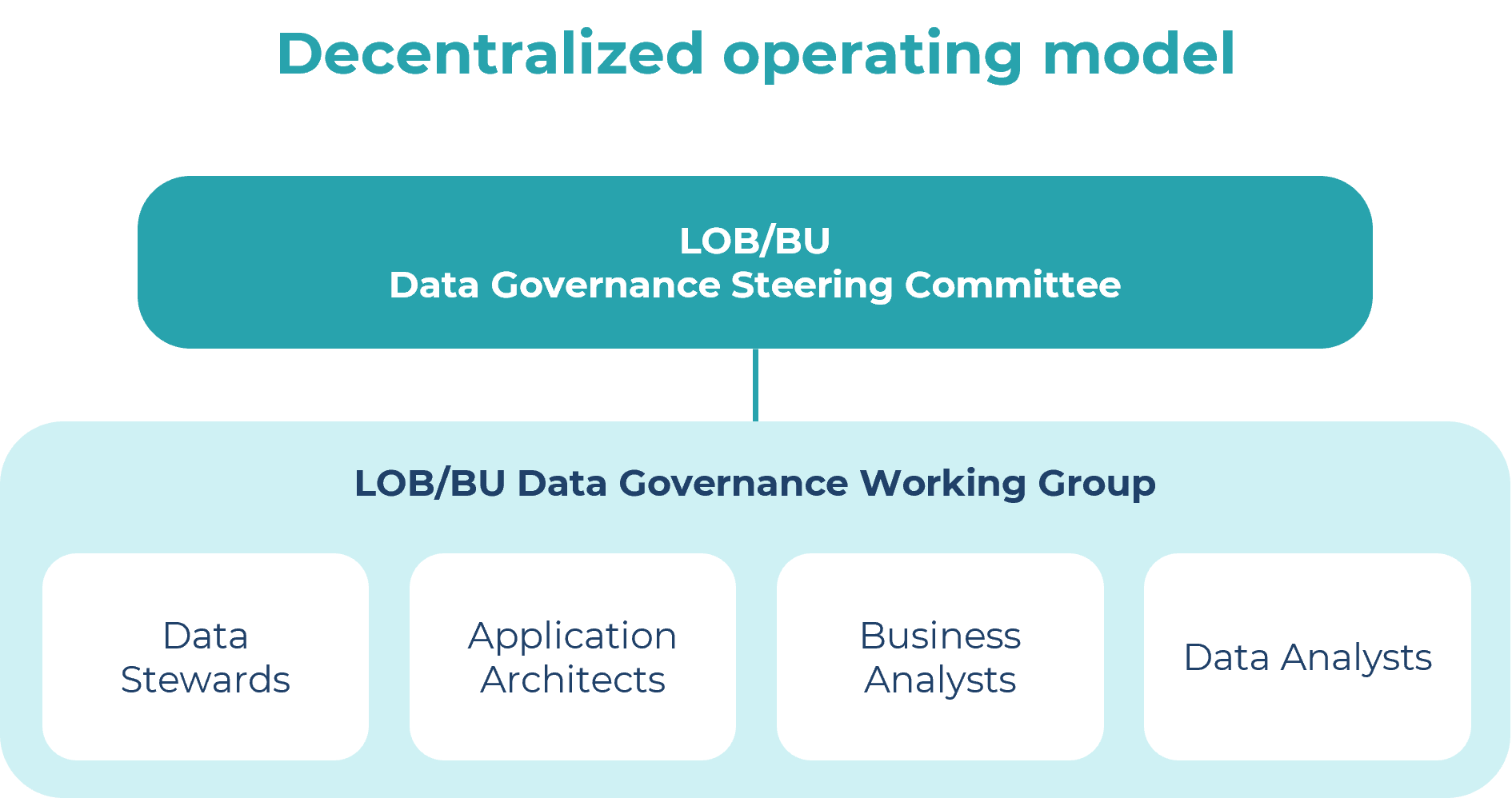
If a centralized data governance model is an orchestra, then a decentralized model is a jazz ensemble. It uses organic improvisation to address data inconsistencies and challenges as they arise. This grassroots approach often originates within a team of employees and requires executive backing to maintain momentum and implement ideas.

The downside is that the employees involved have other primary roles and no formal data governance duties. This can make it difficult to sustain data governance when other tasks pull them away. Committees in this model often struggle with decision-making, creating strategies, and implementing change. Moreover, without a single person in charge of data governance, enforcing roles and accountability is challenging.

| LACO
Pros
  • Relatively flat organization.
  • Informal data governance bodies.
  • Relatively quick to establish and implement.
Cons
  • Consensus discussions tend to take longer than with a centralized model.
  • Many participants, which can compromise governance bodies.
  • May be difficult to sustain over time.
  • Provides the least value.
  • Difficult to coordinate.
  • Business as usual can interrupt data governance.
  • Issues around data co-ownership and accountability.

3. Hybrid data governance

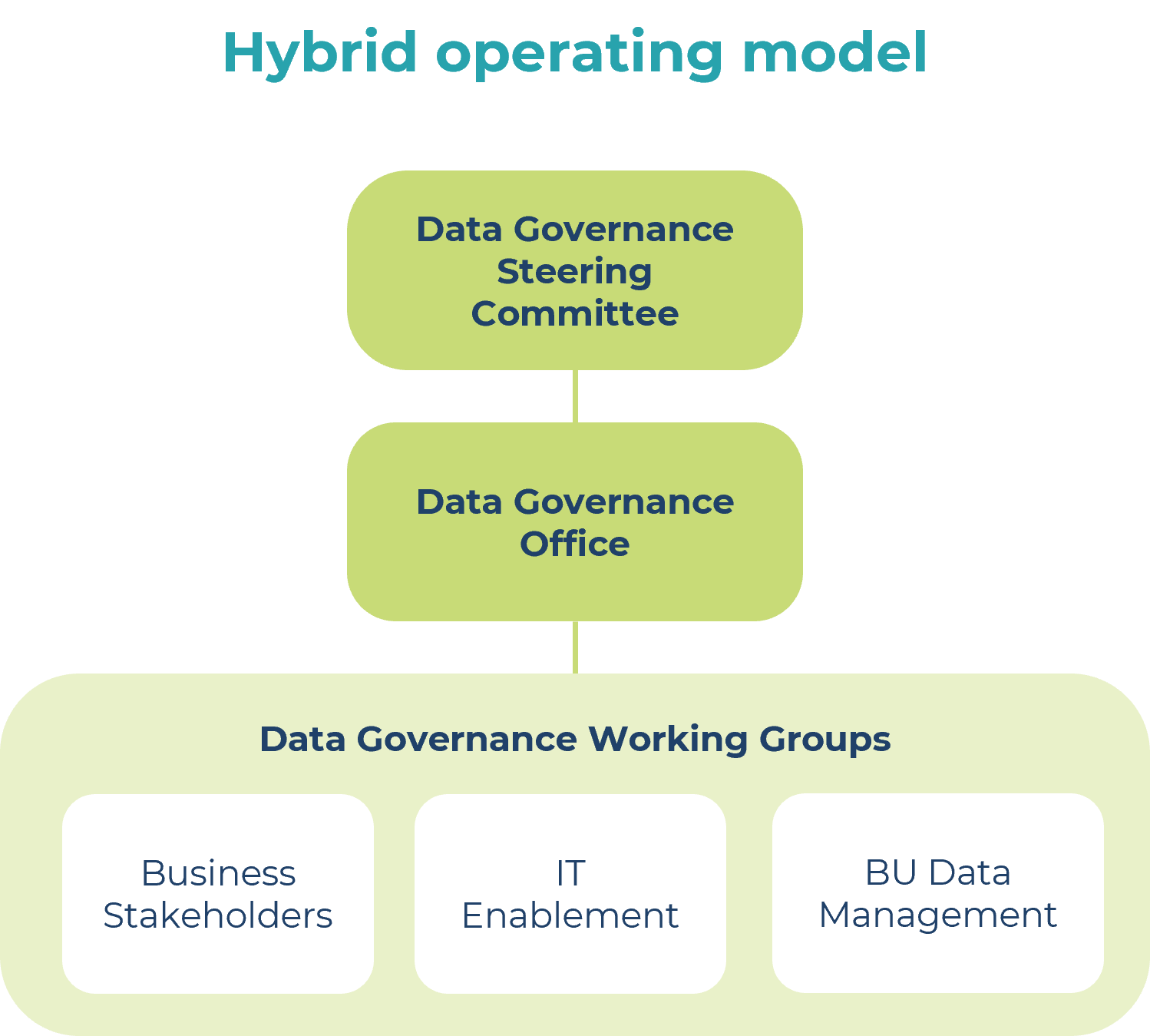
A hybrid data governance model combines the best aspects of both centralized and decentralized models, while reducing their limitations. It features a centralized data governance office complemented by a cross-functional, decentralized working group.

The office may comprise various roles, such as a data governance lead, program manager or business analyst, and possibly, a data quality team. The decentralized working group consists of experts from different business units, as well as IT representatives. This offers flexibility and enables direct involvement of the people who are impacted by the data.

Accountability is embedded in the structure of a hybrid data governance model, with the steering committee ensuring decisions are enforced and the working group participants reporting up through corresponding steering-committee-led business lines.

| LACO
Pros
  • Centralized structure for establishing appropriate direction and tone at the top.
  • Formal data governance lead serving as a single point of contact and accountability.
  • Data governance lead position is a full-time, dedicated role, so data governance gets the attention it deserves.
  • Working groups with broad membership for facilitating collaboration and consensus building.
  • Potentially an easier model to implement initially and sustain over time.
  • Pushes down decision-making.
  • Ability to focus on specific data entities.
  • Issues are resolved without requiring the whole team to participate.
Cons
  • Data governance lead position is a full-time, dedicated role.
  • Working group dynamics may require prioritization of conflicting business requirements.
  • Too many layers

4. Federated data governance

A federated data governance model is like a franchise system. Regional or divisional data governance offices execute the program within their areas. To maintain consistency across these offices, an enterprise data governance office ensures collaboration and uniformity.

This model enables regional offices to focus on the data types that are critical to them, irrespective of their relevance to the entire organization. However, potential conflicts between divisional and enterprise priorities may arise, so an effective conflict resolution process is crucial.

| LACO
Pros
  • Centralized enterprise strategy with decentralized execution and implementation.
  • Enterprise data governance lead serves as a single point of contact and accountability.
  • “Federated” data governance practices per line of business (LOB) to empower divisions with differing requirements.
  • Potentially an easier model to implement and sustain over time.
  • Pushes down decision-making.
  • Ability to focus on specific data entities, divisional challenges, or regional priorities.
  • Issues are resolved without requiring the whole team to participate.
Cons
  • Too many layers.
  • Autonomy at the LOB level can be challenging to coordinate.
  • Difficult to find balance between LOB priorities and enterprise priorities.

5. Agile data governance

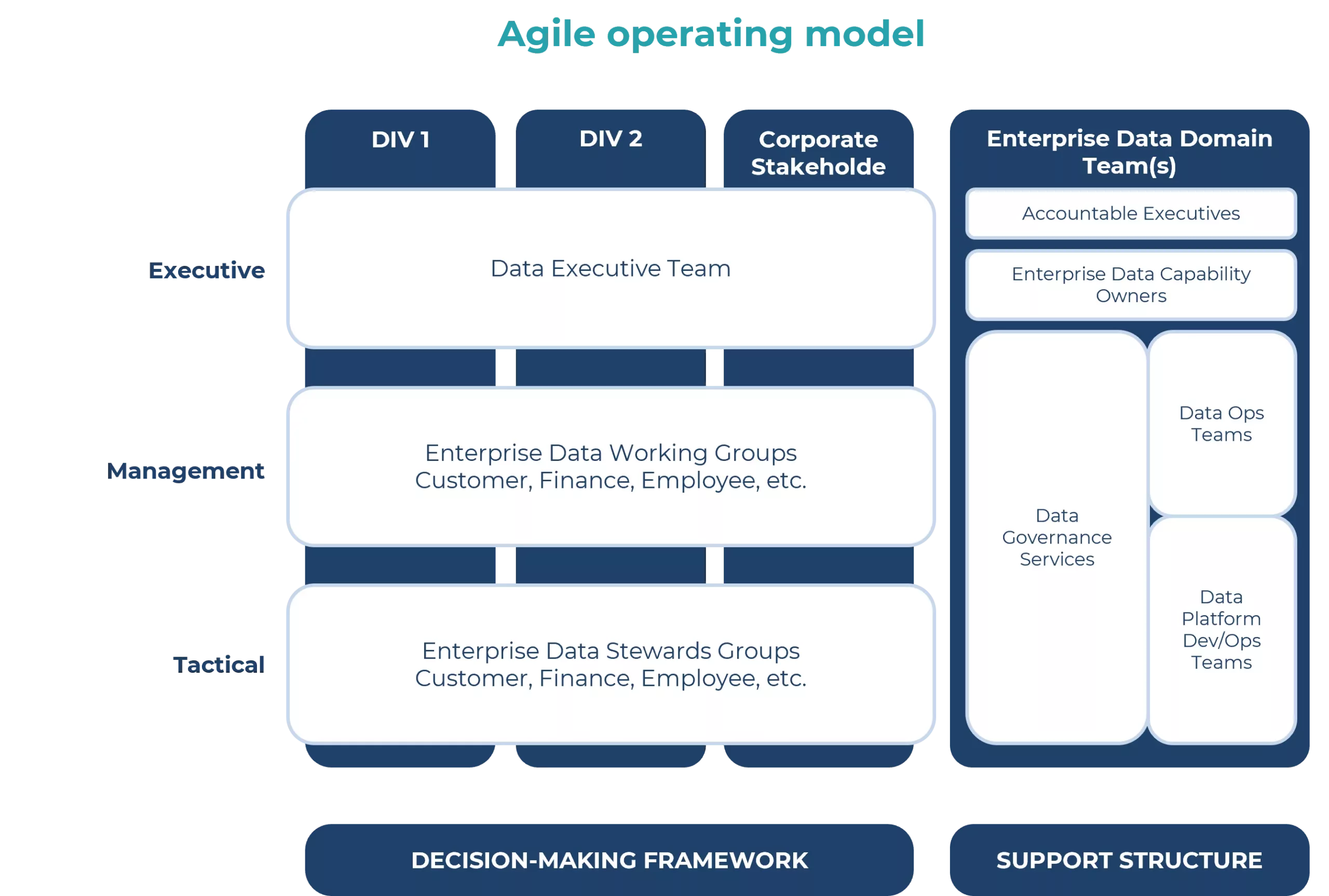
Agile data governance is an emerging operating model that resembles a vibrant marketplace. It’s an approach in which everyone contributes to the company-wide data resource, supported by data catalogs and tools equipped with machine learning and artificial intelligence.

As this model evolves, it promises faster adoption, better alignment with business objectives, and the emergence of new capabilities. However, this empowerment also comes with shared responsibilities, including contributing to data knowledge, adhering to data protection guidelines, and ensuring approved data usage.

The agile data governance model encourages a supportive framework, pushing policies as close to the end user as possible. It fosters collaboration and positions the data governance office as a shared service that provides guidelines in support of business objectives.

Technology, especially data catalogs, plays a pivotal role in ensuring guidelines are followed and contributions are tracked. This approach resembles a federated data governance model, with decision-making involving cross-divisional and cross-functional groups, multiple working groups, and a data steward community. Accountability at senior levels and the identification of who is responsible for data are integral parts of this model.

| LACO
Pros
  • Focuses on providing support to staff who work with data.
  • Staff are empowered, but also expected to contribute to the corpus of data knowledge.
  • Staff follow guidelines rather than rigid, prescriptive procedures.
  • Supports data end users.
  • Ensures investment in communication and training on how to deal with data needs (not just high-level statements of what needs to be done).
Cons
  • This modern approach requires tools like a data catalog.
  • For organizations used to traditional governance structures, transitioning to an agile model can be a complex and challenging process.
  • This model requires a significant cultural shift within the organization.

Important considerations for defining data governance operating models

To choose the appropriate data governance operating model, you need an in-depth understanding of your organization’s culture. If your chosen model doesn’t align with the company culture from the outset, implementation will be challenging. Make sure you consider the company’s values, leadership style, and communication culture. You also need to decide how centralized or decentralized you want the model to be. And it’s crucial to align decision-making entities with the existing organizational structure, which leverages their authority to foster accountability throughout the model.

While shaping your operating model, bear in mind the principle of thinking globally and acting locally—conceive your future state but focus on what is immediately attainable. You will adapt the model over time. At LACO, we dedicate considerable time to pinpointing the best operating model for each client. Occasionally, this means scaling back the future-state model until the organization achieves a certain level of maturity.

It’s important to note that no two companies will have identical models due to their different organizational cultures. This means you can’t simply copy a model from another company, not even one in the same industry.

To get started, check out this list of actionable steps that can help you enhance your data governance operating model.

  • Understand your business needs: Every data governance operating model should be grounded in the strategic priorities of the business. Understand the needs of your stakeholders and build your model to meet these needs.
  • Create a data governance council: This council should comprise representatives from different business units. They will be responsible for making decisions regarding data policies and standards.
  • Define roles and responsibilities: Clearly outline the roles and responsibilities of everyone involved in data governance. This will help to avoid confusion and ensure accountability.
  • Manage the change: Data governance is an evolving field, so it’s vital to keep your team up to date with the latest trends and best practices. Change management is also a crucial part of successful implementation, as well as providing ongoing education and training.

Remember: people are a critical element of every data governance operating model. Assess the people and roles within the model you choose carefully. Disregard titles and focus on assigning the right people to the right roles at the appropriate level of the organization. Ensure they’re good decision-makers and that their managers are happy for them to commit the necessary time. And if you can’t initially fill all roles with the ideal people, focus on the most important roles.

With a solid data governance operating model, your organization is better equipped to handle data challenges, make informed decisions based on accurate data, and drive growth through the effective utilization of data. It’s well worth the effort. And don’t forget, this is an ongoing process. It will require continuous monitoring and adjustments to sustain it over time. You’ll scale it as you go and watch it mature. Always aim for progress rather than perfection.

Designing an effective data governance operating model2026-02-16T08:44:08+00:00

Building a data governance framework for Federale Verzekering-Assurance

To harness the power of data and fortify its position in the market, Federale Verzekering-Assurance called on the data intelligence experts at LACO. “In order to gain the most value from our data assets and manage them efficiently, we needed a structured approach to data management,” says Amandine Rouvroy, Chief Data Officer at Federale Verzekering-Assurance. Using its battle-tested data governance framework, LACO tailored a data governance strategy that provided the insurer with the strong foundation it required for ongoing data governance.

Setting the stage:

Becoming data-driven

Established in 1911, Federale Verzekering-Assurance is a mid-sized group that employs more than 600 people and had a consolidated balance sheet of €4.1 billion in 2022. The long-standing insurer is well accustomed to adapting to changing market needs. And in today’s business climate, this means transforming into a data-driven organization.

In September 2021, Federale Verzekering-Assurance launched Shape25, an ambitious and strategic program that includes a large-scale digitalization effort. The insurer’s corporate strategy rests on three pillars: “Eliminate complexity,” “From transaction to relation,” and “Build mutual trust.” In other words, by the end of 2025, it aims to simplify its customer relationships, offer more contact options, and create more mutual trust.

The problem: Data quality issues and increasing regulatory pressure

For the insurer’s customer-oriented and data-driven corporate strategy to succeed, reliable data is essential. But ensuring this reliability hasn’t always been easy for the sizeable company: “If you’re working in a silo and only using data from one department, it’s not that hard to ensure data quality,” explains Amandine. “But in a large company, we work with transversal data across multiple departments, such as when preparing marketing campaigns. This makes maintaining data quality more difficult. For example, we’ve had an issue with customer email addresses. They’re used by almost all our services but stored in separate databases. And those databases don’t always communicate seamlessly with one another.”

Along with data reliability, the insurer must also contend with increasing regulatory pressure. “Not only does the National Bank of Belgium impose data quality requirements, but the EU has also introduced new regulations such as DORA, as well as mandatory sustainability reporting in the form of ESG disclosure,” continues Amandine. “Without proper data management and governance, it would be very difficult to meet these requirements.”

The result: A tailored data governance framework

To design a tailored data governance framework, LACO first creates some basic building blocks, such as strategy, organization, directives, measurement, technology, communication, and change management. These are the stepping stones that lead to success, and it’s important to put as many of them in place as possible within the first few months.

At Federale Verzekering-Assurance, this approach resulted in concrete deliverables for each building block, including:

  • a data governance charter (strategy) with an associated operating model (organization);

  • an example of a data quality policy (directives);

  • a measurement dashboard metrics definition (measurement);

  • a business glossary and data dictionary (technology);

  • a communication plan and training plan (communication);

  • a change plan (change management).

The data governance working groups at the company were also able to immediately put many of these deliverables into practice through real use cases.

With these foundational data governance capabilities well and truly established, Federale Verzekering-Assurance has hit the ground running. “LACO gave us a solid foundation for data governance and a customized data governance strategy,” concludes Amandine. “With this, we’ve been able to further develop our capability catalog and create a multi-year roadmap for its delivery—an achievement that wouldn’t have been possible without the foundational work performed by LACO.”

Building a tailored data governance framework?

Building a data governance framework for Federale Verzekering-Assurance2026-02-03T11:14:56+00:00

EuroChem Antwerp lays the foundation for a data-driven organization

The Antwerp branch of fertilizer manufacturer EuroChem knew it was sitting on a goldmine of data. It decided to call on the services of data intelligence specialist LACO to mine this resource. The result is operational excellence that’s now also easily measurable and reportable. Now EuroChem is well on its way to becoming a more data-driven organization.

Setting the scene:
a key production plant

EuroChem Antwerp is a manufacturing facility with good logistics infrastructure within the EuroChem Group with its headquarters in Switzerland. “Our end product is fertilizer granules for use in agriculture and horticulture,” explains Bernard De Vriese, the company’s IT Manager. “We produce about 2.2 million tons of these mineral fertilizers here every year.”

EuroChem Antwerp is also an important logistics hub for the group, thanks to its strategic location in the Port of Antwerp. From there, EuroChem serves the international market. The facility employs 400 people and has an annual turnover of €1 billion.

The problem:

getting the data right

“We are purely a manufacturing company,” emphasizes Continuous Improvement Specialist Pieter Callens. This is evidenced by how the company employs data. Like any industrial manufacturing company, EuroChem generates a huge amount of data. In addition to the usual ERP data from finance and HR, there’s also lots of supply chain and warehouse data and even data about energy consumption — crucial for a chemical company seeking to optimize its cost structure.

And then of course there is all data generated by the production facility itself where IoT technology allows data from production processes to be automatically recorded, from standard process parameters over minor disruptions to major interventions. This production data is used intensively, although mainly for operational purposes. “Our production line simply wouldn’t run without all that information,” says De Vriese. Not only was this data used tactically rather than strategically, but all too often it was processed in a manual, non-automated, and time-consuming manner. In addition, there was a significant risk of human error and unreliable, compromised data.

Having one version of the truth is a very attractive prospect for management. But if everyone is working on their own Excel file, discrepancies can arise, creating the danger that before long, everyone is talking about a different thing.

Extra challenge:
sharing the data

What didn’t help, of course, was that the data was spread across different islands or silos within the company, stored using different technologies, from Access databases to Excel and XML files. “Our way of working has changed so much since the takeover of the Antwerp factory by EuroChem,” says Callens. Until April 2012, EuroChem Antwerp was part of the chemical giant BASF, and the two companies still share a site and a number of central services and logistics activities.

However, the change meant that EuroChem Antwerp had to establish most of the support services that BASF used to provide, from finance to HR. “We didn’t always have the necessary experience in-house,” Callens admits. This has made reporting difficult. Not only was the data not integrated, it was also not automatically shared between the different data silos. The reporting that did take place was quite static and required a lot of repetitive manual work. An additional driver for the data project was the planned migration from Oracle to SAP, another consequence of the carve-out of EuroChem from BASF. Because some data was in danger of being lost during the migration, the company wanted to first secure all its data on a separate platform, which would be connected to the new ERP environment via loose coupling.

The solution:

a data platform based on Microsoft Power BI

“To get rid of all those islands, we needed a central data platform with a central reporting mechanism,” says Callens. In his additional role of Data Management Specialist, Callens is also the main point of contact for the creation and use of reports at EuroChem Antwerp. “Concepts such as BI and data warehousing could provide a solution to the problems we’d been struggling with for some time. One of them was to arrive at a consensus on how to calculate important Key Performance Indicators based on the now centralized and controlled data. That process is now fully underway, thanks to LACO.”

Data intelligence specialist LACO advised and supported EuroChem Antwerp as they implemented an integrated platform that groups all their data and unlocks it for reporting and analytics. “I had previously worked successfully with LACO,” says De Vriese, explaining why he chose the local supplier. To achieve the necessary internal buy-in for the ambitious project, they decided to move forward in steps. “We first did a Data Strategy study with LACO. After we had done a thorough analysis with the stakeholders from the various departments, we took our assessment to the local Board of Directors to ask for the green light. And we got that quickly.”

And finally: data-driven business success through operational efficiency

In addition to an architectural blueprint, a concrete implementation roadmap, aimed at rapid value creation has been delivered as part of the Data Strategy study. EuroChem and LACO drew up a priority list to identify the most important benefits. “We started by creating a value map,” Callens remembers. “One of the priority decisions that has resulted from this is to allow the business to work more with reports.”

At LACO’s suggestion, EuroChem opted for a highly iterative approach to the implementation of the new Microsoft data platform. This was carried out by a fixed team, involving the end users from the outset. Callens has nothing but praise for LACO’s functional analyst: “He was very professional and customer-oriented. And that was never a given, because he had to dig into our context again and again and then respond very flexibly.”

Soon the results were clear. Staff now have to do less manual work in Excel. This increases operational efficiency and reduces human error. And because EuroChem now has a source of high-quality reference data, the much sought-after single version of the truth is also gradually becoming a reality and the delivery of the strategic KPI’s is on its way.

To make this possible, a number of standard reports were also developed. “A striking example is the report for the various capital expenditure initiatives within our branch.” Reporting on capital expenditure turned out to be not only very complex but also something that quite a few departments struggled with. This included the finance department and general management, who must be able to identify any overspend. But it also included engineering departments with project managers, up to and including asset managers, who are responsible for the maintenance of the installations. “In the past, all those colleagues had to use complex Excel files that we feared would have only a limited lifespan. Today, most of those reports have been replaced by a BI report that’s simple and fast to create, as well as flexible to use and always up to date.”

“The most important work has been done,” concludes De Vriese. “The foundation is there.” This foundation provides EuroChem with a solid launch pad for the future as it grows into a true data-driven organization.

Ready to become a data-driven powerhouse?

EuroChem Antwerp lays the foundation for a data-driven organization2026-02-03T11:18:05+00:00
Go to Top